Interview
Blog
Data does not play golf: Niklas Bergdahl on why Trackman started measuring the body
Niklas Bergdahl leads Trackman University. With 3D Motion Analysis, Trackman now measures the body alongside ball and club. He explains why that step took so long, what it changes in a lesson, why one camera is not 3D, and why every golfer and coach should go on a data diet.
Author
Timothy Beumer
Published
Category
All
LAST UPDATED

Author
Timothy Beumer
Timothy is the founder of Findoori, with 15+ years of experience across the golf industry. Having worked closely with indoor golf centers and visited locations around the world, he is driven to build a central platform that helps golfers discover where to play and helps centers grow their visibility.
Inside the world of indoor golf.
New technology, insights, and stories from indoor golf centers, delivered to your inbox.
Get updates on our latest blog posts.
Back with an extra club in the bag
Niklas and I worked together at Trackman for eight years. Then he left, and three years later he came back. The reason, he says, starts on a golf course in Sweden.
"My dad is a PGA Master Professional. I grew up on a golf course, golf was my entire life. During covid, when you are forced to be at home a bit more, I started asking myself: is golf everything I want to do in life? Is there another part of me that wants to explore something else?"
He left Trackman for another sports technology company, this one focused on AI-powered cameras for multisport. "It was really cool. But pretty quickly I realised that my core passion is golf. And Trackman is an incredible company, not just because of the growth, but because of how it is expanding into more areas of golf rather than staying only at the top level of the game." Three years after leaving, he was back.
He is relaxed about the idea that you never return to a company you have left. "I do not plan ahead much. I am more about exploring and being curious. The things I learned in those three years just added to my skill set, and they help me do things at Trackman now that I could not have done if I had stayed." At Trackman he had run the customer service team and then worked as a product manager. The years away were spent in content marketing. That combination is now what Trackman University runs on.
Why a sports technology company invests in education
Trackman University exists because of the founders, Niklas says. "They come from academics and research. Knowledge sharing has always been an essential part of that."
The concept dates to around 2010 or 2011. "Fredrik, our founder, was going around giving presentations about the data. At the time it was partly a branding effort, but it was also telling coaches what the real power behind the data was: the definitions of club path and attack angle and how they relate to ball flight. You could call it an investment in lead generation. What keeps us true to it today is that it unlocks so much more from the hardware. It is really a customer success thing."
That mission has widened. Trackman used to be something a coach owned. Now it is in commercial indoor centers and on driving ranges, in front of golfers who practise on their own. "So many more players are being exposed to so much data. Our challenge is to make sure we do not overwhelm them."
His entry point is simple. "Take carry. How far do you actually fly the ball? That is relevant for every golfer. The next level is to stop thinking about your best shot and start thinking about ten shots and your typical dispersion. Golf is not chess. Golf is more like having a shotgun, and hoping that somewhere inside that circle is where the ball lands on the course."
Raising the floor, not replacing the coach
I asked how Trackman University avoids becoming a substitute for the coach it is trying to serve. Niklas does not see the tension.
"This is not about replacing the coach at all. It is about raising the standard of golf knowledge across the board." He gives an example from the day before our call. "I played with a friend who hits a straight push right or a big hook left. He was talking about his swing in a very old school way, in to out and so on. So, I said: here is the club, here is where it is moving, here is where the face is pointing. If the face points where the club is moving, the ball goes straight. If you close the face, the ball curves left. And he went, so I need to change my club path. Yes."
"Once a player has that foundation, the coach can start talking about what to do in the setup or the swing to change that path, instead of it being feel based and subjective. One of the biggest things Trackman brought to golf is a standard language around ball flight and club delivery. You even see it in broadcasts now, ball speed, launch angle, curve. That means coaches no longer have to start every lesson by explaining what a parameter is. We raise the floor for everybody."
That does not mean every golfer should start with data. Between twenty and fifty percent of visitors to an indoor center have never held a club, and Niklas is clear about what those people need. "Data does not play golf. The golfer plays. Data is only there to validate what is happening. In the early days a lot of coaches and players thought the goal was to zero out the path and the face. That is not the goal. There is a big human layer, and Trackman should be the validation layer underneath it."
"For a new golfer, I do not even know if they should use data at first. Pull up the ball flight, hit a few on the range, play an easy par three course. The first thing they will ask is how long the hole is, and then they will look at the carry number. Interest in data builds over time. Do not throw yourself to the tigers with all the advanced numbers on day one."
Is a guided beginner mode something Trackman is working on? "Definitely. A more personalised journey, where we can say: here is where you are, here is your baseline, here is your progression and the next step. Practice has to be fun, engaging and sticky. If it is too hard you stop, if it is too easy you stop. Finding that sweet spot at scale, for every type of golfer, is complex. But it is very much where we are going."
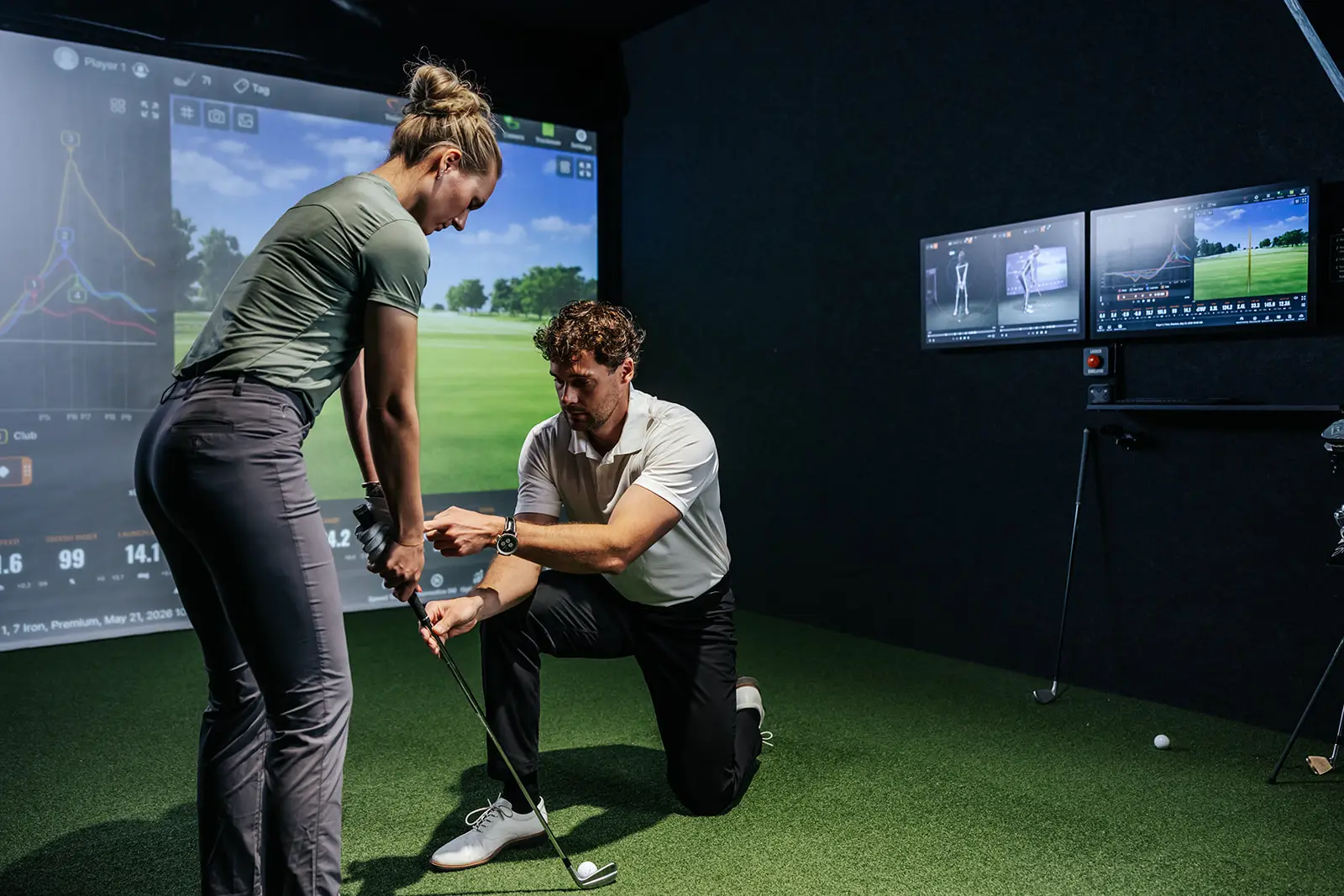
Why the body, and why now
Trackman has always been about ball and club. So why the body?
"It is a natural step. We started by tracking the ball to understand why it flies the way it does. That comes from club delivery, so we tracked the club, and we spent years making sure we tracked the right things, accurately, robustly, so that people trust the numbers. But coaches and players have always referenced the body, through video or through feel. So the body was always the next layer."
What held it back was technology. "Biomechanics and 3D used to be for marker-based systems. You strap a lot of things to your body, you do a complex calibration, and you get graphs and numbers that are very hard to decode. What changed is that AI let us train optical tracking through cameras far better, and crunch far more data. That accelerated the opportunity."
Trackman chose to build it rather than buy it. "We have been approached by many companies, all with great ideas about AI body tracking. But we took the stance that if we track the body, we do it with our own people and we own the code. We set up our own team about four years ago. It turned out to be extremely difficult, especially with the Trackman philosophy: no markers, non-intrusive, fast and accurate at the same time. You put up two cameras, calibrate them with the Trackman unit, and you get accurate numbers. That took time, which is why other companies got their solutions out earlier."
He does not apologise for that. "We are an end-to-end company. Research, feasibility, product, code, support. Whatever we put in the market, we have to be proud of it and it has to be trusted. If there are issues, we fix them ourselves, we are not tied to someone with a different interest. That is also why Trackman is more expensive than most. And it is why we always want more data, but never more data than is actionable."
Why one camera is not 3D
Most golfers already film their swing. What does 3D add?
"Film yourself down the line. Move the camera ten centimetres, or a little higher or lower, and the swing looks completely different. Your shoulder alignment, your takeaway, whether the club is on plane, it all changes with the camera position. Video is a great reference, but there is no depth and no metrics. You draw lines on it and you are at the mercy of putting the camera in exactly the same place every time."
"With 3D, the Trackman unit sets up a calibrated coordinate system. It knows the target line, and the target line is created from where you actually hit the ball. So the cameras and the radar share the same zero, and it does not matter exactly where the cameras stand, or whether it is a different session. Your body movement is always referenced to that zero."
That zero is the detail Niklas keeps coming back to. "Other 3D systems are calibrated to a fixed room, so the ball has to sit at one spot. Move it and the system tells you that you did something wrong, when all you did was move the ball. With Trackman the target resets to wherever the ball lies. A player should be picky about that, because it is what makes the data relevant."
And the numbers themselves. "Take the midpoint between your shoulders. On video you say, you moved a bit more here. With 3D we say: first swing five centimetres towards the target, second swing three. Now you know how much and in which direction. That is actionable for a coach and a player, instead of an opinion."
He is blunt about single camera systems. "One camera is not 3D. A camera measures up and down and left and right. It cannot tell you depth. Some systems use AI to build 3D from one camera, and I would not call that serious. If you are doing 3D you need two angles. We could make it seem easier with one camera, but we feel responsible for the data we put out."
Capacity, competency, and the end of the swing model
Ball and club data is physics. A collision between a metal object and a ball. The body is harder.
"You and I might both want a five-degree negative attack angle, and we might get there in completely different ways. We are built differently. In biomechanics we talk about capacity: your limb lengths, your strength, your range of motion. A Ferrari and a Fiat. Then competency: given that capacity, can you actually make the motion? If your right hip does not rotate internally, it will be very hard to turn your pelvis. You will sway instead."
This is where he thinks golf coaching has stagnated. "For years we looked at a swing model, a tour player or a set of lines, and tried to fit everybody into it. I do not think that is serious. There are a few laws and principles, and then you map them to what the player wants and what they are capable of."
The measurements begin before the swing. "The ball lies still. That is the hardest thing about golf and also the blessing. Because the cameras are calibrated to the radar, we measure your setup: ball position, stance, distance to the ball, whether your torso and pelvis are open or closed. Before you move the club we already have numbers on how you set up, and setup has a huge influence on what happens later."
When he coached the Swedish national team, that was done with alignment sticks laid in a cross. "We were very picky that players got their fundamentals right before swinging. So many players say, it feels weird today, and it is because they have no reference. Over time you drift further from the ball and nothing works. Being able to neutralise your setup is so important. Now you get the blueprint automatically: how you set up, how you swing, how you deliver the club when you hit your best shots."
So is it fair to call it a three-layer system, ball, club, body? "Yes, it is a three-layer system. And the body layer is where players can really improve by exploring cause and effect. What if I move more behind the ball? What if I stand closer? Then look at what changes in the club delivery. That is what we did as kids, we tried things. As adults we hit the same shot over and over and expect a different result."
A shot that leaks right
I gave him a concrete case. A player pushes one right. The club data says the face was open. What does the body add?
"First, open relative to what? Relative to the target or relative to the path? That tells you whether the ball curves or starts straight right. Then: is the face open because you swing out to the right and hold it, or because you open it to keep the ball out of the left side? You need the bigger pattern first."
"Then I go to alignment. Where are the shoulders, the pelvis, the stance pointing? If you set your whole body up ten metres right of the target, it was actually a great shot. You just aimed wrong. And I am not saying alignment must be zero. Our research already shows people hit any shot they want from open or closed. Across our samples there is no reliable link between closed shoulders and swinging right. That is the complexity. But you should know what your alignment is, and what changes when you change it."
The same goes for ball position. "The face closes through impact, so in theory a ball further forward lets you close it more. But some players hold the face open when the ball is forward. There is no one rule to rule them all. So I would start with fundamentals: alignment, ball position, exploration. And then the 3D metrics: is the face open because I sway instead of turn? If I turn, the face may close more easily. If I slide, I tend to hold it."
He is upfront that it is early. "One thing we do not measure is the grip, and I think the grip has a big influence on face delivery. And there are so many directions and possibilities. That is also why Trackman University exists: not just to teach, but to do the groundwork. With the market share we have, we are collecting millions of shots with body, club and ball data together. No research has ever come close to that. But there are a lot of different individuals hitting those shots, so we have to be careful about what we conclude."
Screening, injuries and sustainable shots
That caution extends to what Trackman will tell a golfer to do.
"We envision a screening step. Either at home with the Trackman Golf app or in the bay: get into an anatomical position, get into posture, show your wingspan, show how far your shoulders rotate. Tell us about the left knee injury. Test hip mobility. Connect those dots and we know your limitations. Then neither the system nor the coach should recommend something you are not physically capable of, or that will hurt you."
He sees that as part of the point. "It is not just about the perfect shot. It is about a shot that is sustainable, so you can play more golf without getting injured. We see a lot of injuries, in professional golf but also in amateurs, from overworking elbows and wrists and backs to get into certain positions. That is a very important layer."
The same applies to AI coaching, which Trackman is not rushing. "There are already systems that tell you: this is a fault, you are in this category, that is bad. Look at the top fifty players in the world. You see a lot of different swings. Any AI assisted coaching we do has to be serious about the research, because as soon as a tip does not work, you decide the system is not for you. It is not important for us to be first. We will get there, but the holistic experience matters more."
Where it is all heading is less ambiguous. "Our company vision is to track every golf shot hit on and off the course, and to connect golfers across the world in a digital ecosystem. Those are our two north stars." With simulators, driving ranges and broadcast tracking on all the major tours already in place, prototypes for automatic on course tracking exist today. "Then the loop is complete. We see your tendencies on the course, we tell you what to focus on in practice, and you take it back out with you."
Inside the bay
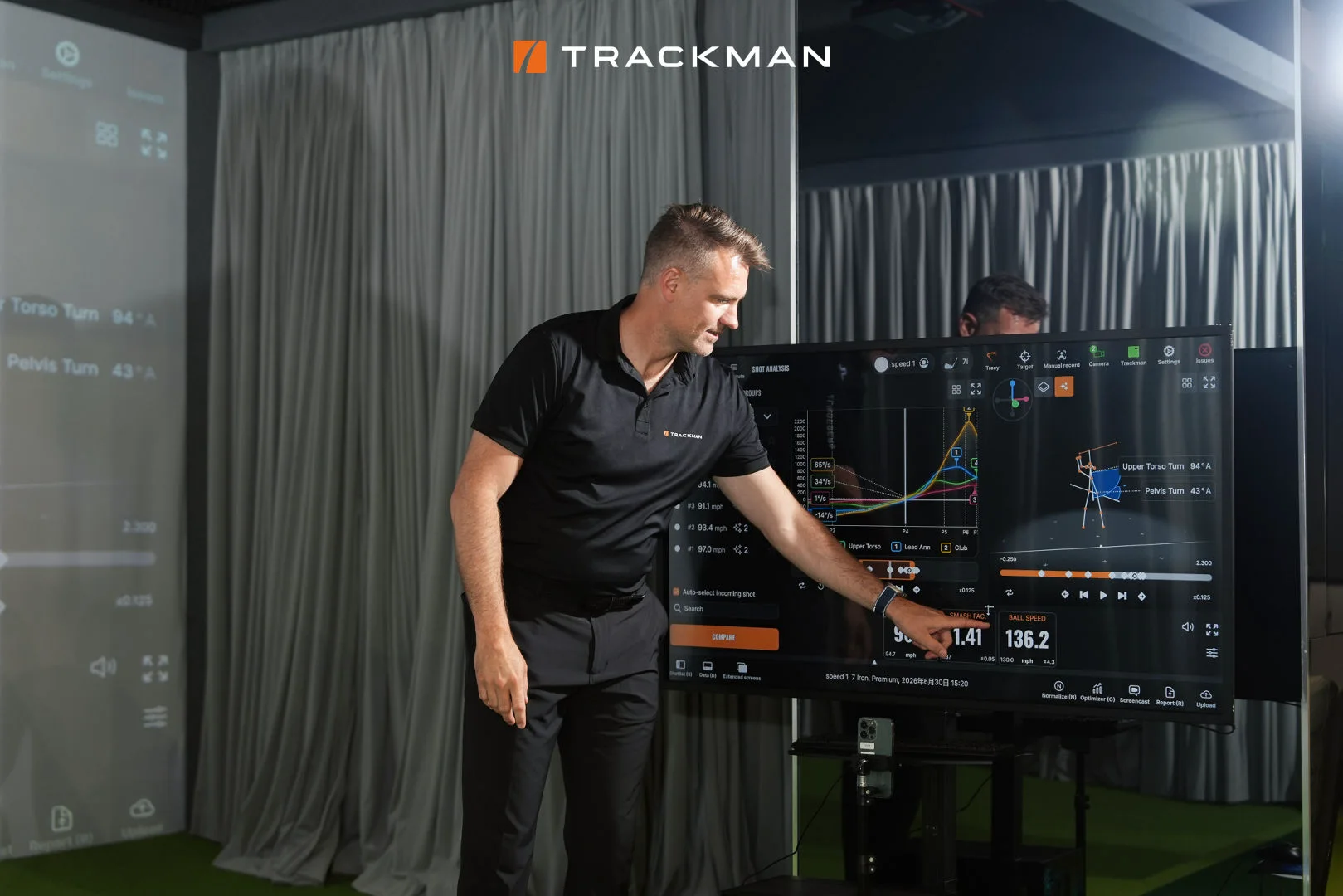
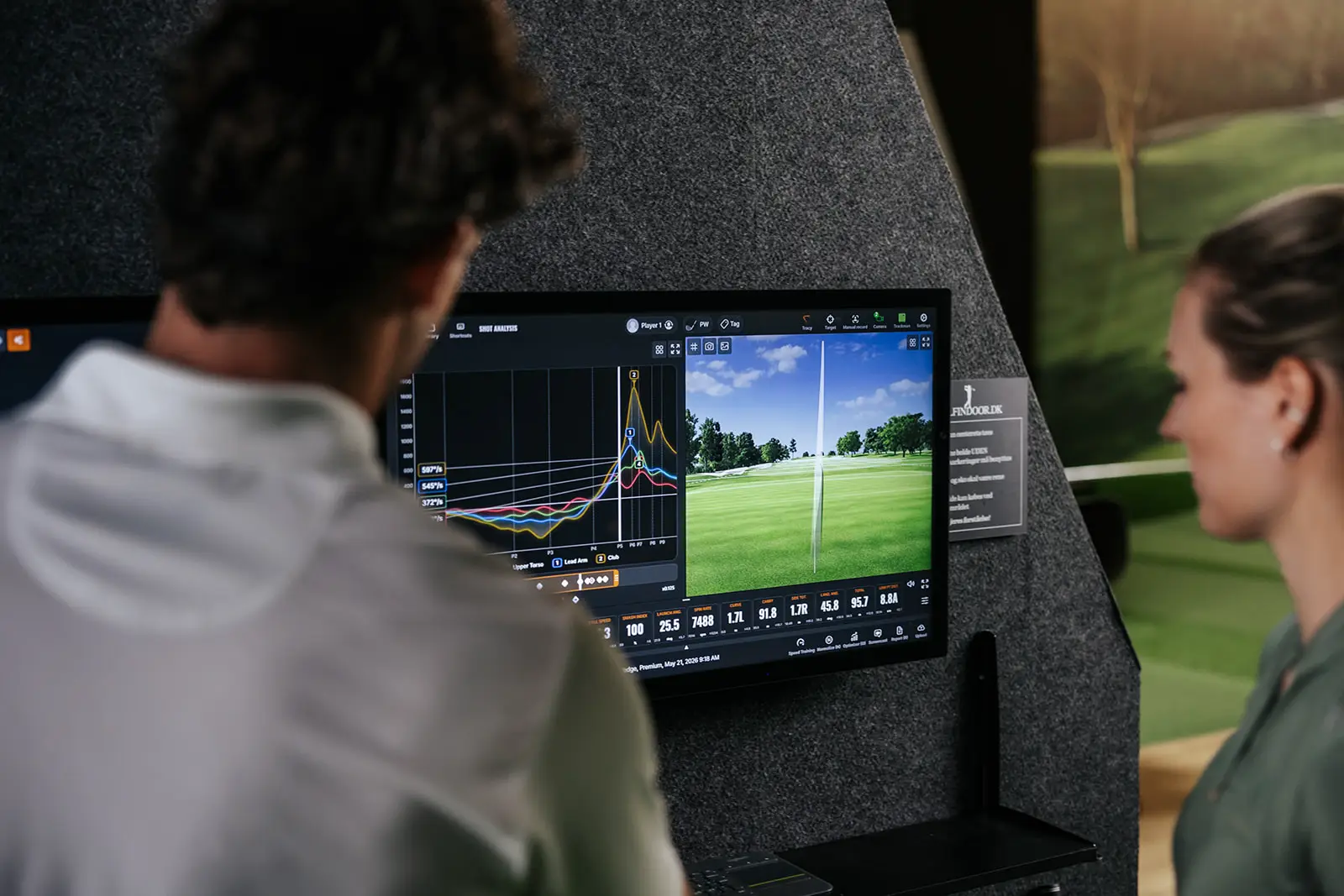
For a golfer who wants to try it, it lives inside Shot Analysis in Trackman Performance Studio. Select your player and club, and alongside the tracer and top view there are two new views. "The 3D view shows a simple avatar of your body, with overlays for how much you turn or lift, plus your setup: ball position, alignment. There is also a graph view, which is the full story of how the body segments move and build speed from the ground up, pelvis to torso to arms to club. Most golfers should stay away from that at first. It needs some education. Once you get it, it is a very effective way to look at a swing."
His advice for using it is the same advice he gives for club data. "Start with very few overlays. Everybody needs to go on a data diet. Pick one, two, maybe three parameters. As soon as you add more, the cognitive load is too much. That goes for coaches too. Decide what you are actually trying to measure, instead of looking at everything and hoping a pattern jumps out."
What a center needs
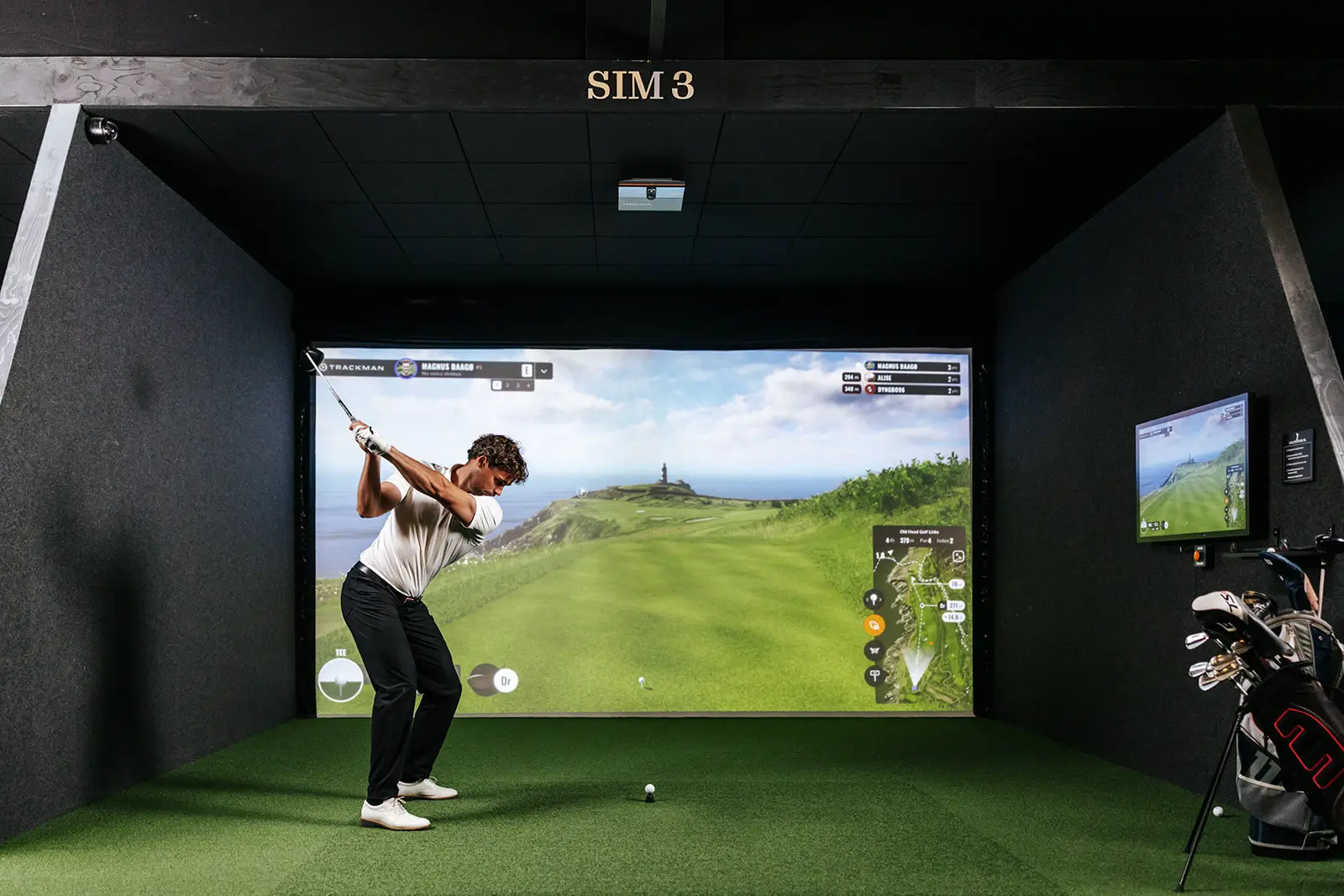
The setup is lighter than most owners expect. "You need two external cameras. The 3D is part of the same software package as the virtual courses, so there is no additional cost beyond the cameras." Three options are supported: iPhones running the Trackman camera app, which works well but tends to overheat in a permanent installation, or one of two USB cameras, a more premium model from IDS and a more affordable Trackman swing camera. "After that it is plug and play. A little tweaking for your lighting, and there are help center articles for all of it."
Is it for every indoor center? "I do not know about every center. But I know every golfer and every coach is helped by having 3D data. If you are purely entertainment focused, you can still offer serious practice to the customers who want it. For the more serious center, I think it is a must have. It shows you are serious about practice and about what you offer."
Stay relevant
Coaches thirty years ago relied on their eyes. Five years from now, does the coach's eye matter more or less?
"Coaches are still very relevant. As humans we like the interaction, the connection, the back and forth. It is like customer service: you always prefer a human to an AI assistant, because you feel they get the nuance. That connection is a big part of a good experience. But technology will let players and coaches find the right thing to work on faster. Diagnosis gets more effective, the tools get more fun. You need both."
So Trackman is not going to replace the coach. It supercharges the coach? "Absolutely. But coaches, like any profession, need to ask: what is required of me in five years? How will coaching be different? In my own role I have to ask how I work more effectively with AI. If you feel afraid of being replaced, that is exactly the moment to ask what you need to do to stay relevant. Some older golfers will still want the old-style coach, and that is fine. It is just going to be a smaller market. Follow the development as much as you can."
He pauses, then sums it up in two words. "Stay relevant."
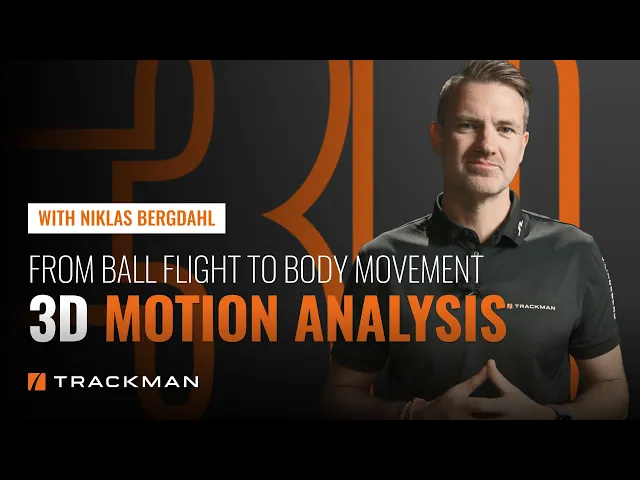
Video: Trackman, 3D motion analysis with Niklas Bergdahl
Other Blogs
Why stop here?
Explore more about indoor golf.